- De Brief
- Posts
- 🇳🇱 King Willem-Alexander and Queen Máxima visit Suriname
🇳🇱 King Willem-Alexander and Queen Máxima visit Suriname

De Brief
December 08, 2025
Happy Monday!
This week we cover the Dutch King and Queen’s visit to Suriname, and Suriname prepares for the oil and gas industry
King Willem-Alexander: History not avoided, this visit marks a new chapter

In the national assembly, the king of the Netherlands emphasized that the purpose of the visit is to deepen the relationship as equal partners, acknowledging their shared history.
He praised Suriname’s democracy and its success in uniting a diverse population under one democratic framework, calling the country “an inspiring example.”
He noted that although the Netherlands and Suriname are separated by thousands of kilometers, they are connected culturally and historically — part European, part Caribbean — and committed to walking forward together.
Suriname’s president called the visit “historic,” being the first visit by a Dutch head of state in over 40 years.
The visit is intended to modernize bilateral relations and create new economic opportunities.
King Willem-Alexander emphasized that history — including painful chapters — must not be avoided.
He described the visit as a symbolic new chapter important to the many Dutch citizens with Surinamese roots.
The visit also highlights cooperation in good governance, an independent judiciary, democracy, and rule of law.
President Simons emphasized Suriname and Netherlands working together towards a brighter future
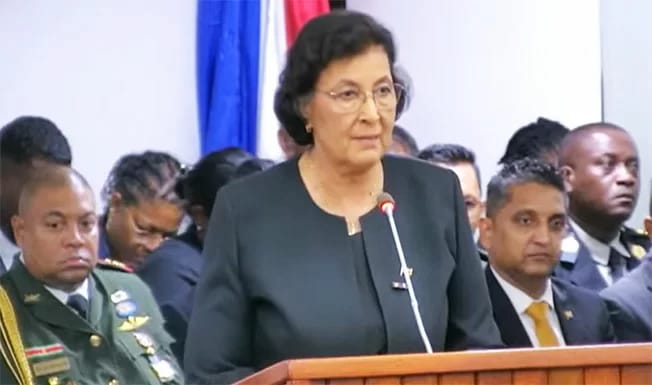
In her speech to the national assembly, the president of Suriname said the Dutch royal visit marks a historic moment — an opportunity for Suriname and the Netherlands to rebuild their relationship and deepen future-oriented cooperation.
She stressed that the process of healing begins with acknowledging the shared past and working together toward recovery and equality.
She emphasized that any new partnership should be based on equality, mutual respect, trust and friendship — not on old colonial hierarchies.
The president pointed out the deep social ties: many Surinamers live in the Netherlands and many people with Surinamese roots live in Suriname, making the two nations in effect “one family.
She called for cooperation beyond government levels — including youths, private sector, businesses and communities — to build a thriving future together.
The president outlined potential gains from cooperation: trade, economy, energy, governance,
According to her, this royal visit provides a rare chance to both face the painful history and use it as a foundation for building a better future together.
Suriname and the Netherlands sign three cooperation documents

Suriname and the Netherlands signed three official cooperation documents during the Dutch royal state visit.
The signing took place at the Presidential Palace following bilateral talks between both delegations.
The cooperation is founded on equality, mutual trust, and a future-oriented partnership.
Ministers responsible for foreign affairs, trade, justice, education, health, infrastructure and spatial planning participated.
The agreements cover multiple sectors, including education, tourism, justice & security, public health, and infrastructure.
One signed document is a declaration of intent for collaboration in the field of education.
Another is an MoU between Invest International (NL) and Suriname’s Ministry of Public Works for financial support to dredge the Suriname River.
A third joint declaration outlines the general framework of bilateral cooperation.
Additional draft documents are under negotiation, including one on socio-economic cooperation and a roadmap with policy priorities.
A key component of the new partnership is a joint approach to addressing the shared history of slavery.
The Netherlands is making 66 million euros available for Suriname's recovery projects

The Netherlands announced €66 million in funding for social projects in Suriname related to healing and addressing the legacy of slavery.
This allocation is part of the broader €200 million Dutch Slavery Heritage Fund established after the 2023 royal apology.
Suriname views the money as a “consciousness and development fund,” not as financial compensation or reparations.
Representatives of descendant communities, Indigenous and tribal groups called for structural support and a mandated commission to coordinate healing and restoration projects.
The economy must accelerate its transformation to 'Suriname 3.0'

Suriname is preparing for a major economic shift driven by offshore oil and gas, with a national “Suriname 3.0” conference planned for April 2026 to create a long-term development roadmap.
Minister Patrick Brunings says oil revenues must be used to transform the economy from “Suriname 1.0” into a modern, diversified, and sustainable system—not to maintain the status quo.
The roadmap shows the gold sector will be phased out, requiring new revenue pillars such as eco-tourism, high-tech agriculture, critical minerals, green technology, natural pharmaceuticals, and modern fisheries.
Oil income is intended to build a strong green-energy pillar including solar, wind, hydropower, bioenergy, geothermal, green hydrogen, and small-scale nuclear, while maintaining Suriname’s >90% carbon sink status.
Government reform is essential: the public sector must shrink, and civil servants will need retraining for jobs in oil, gas, and green industries, as most new jobs will arise in the productive private sector.
Staatsolie warns of major gaps in local capacity—shortages of skilled technical workers, certifications, HSE and quality standards, and training institutions—requiring urgent investment in local content.
The rapid growth of offshore activity is visible at the Kuldipsingh Port Facility, where major international companies now operate directly in Suriname, proving local firms can compete when prepared.
The 2026 national conference aims to establish a national oil & gas development plan, green-economy investment strategy, public-sector reform program, binding local-content rules, and a long-term Suriname 3.0 roadmap.